4 posts tagged with "evaluation"

View All Tags

Agent skills for configuring and evaluating vLLM Semantic Router

· 10 min read
Anup Sharma
Engineering @ Sarvam AI
Park Soobin
Router Models & Inference Runtime Lead @ vLLM Semantic Router

We sent a coding question through a local vLLM Semantic Router. It came back HTTP 200 with the right route headers: the code-route decision and an upstream response path. It contained no answer. A 128-token cap had ended the backend's reply while it was still reasoning. Every check that looked only at the status code or the route passed; the user still got nothing.

That is the gap these skills address. A request reaches the Router through a public entrypoint. The Router evaluates signals, chooses a decision and algorithm, selects a backend, and applies recipe-scoped plugins. A useful assistant must know where in that chain an observation came from. A healthy process does not prove a request took the intended route, a correct route does not prove an answer arrived, and an improved benchmark score does not prove two runs were comparable.

We have started publishing focused agent skills for those jobs. They give a coding assistant a short workflow, point to the current commands and contracts, and say which evidence to preserve. This work was inspired by llm-d's skills article. Here, the unit of work follows the Semantic Router's entrypoint, recipe, decision model, and measured request. That scope matters: starting a process, selecting a route, delivering an answer, and measuring a workload are four different results.

To try one, give a coding agent with terminal access a one-line prompt:

Read https://vllm-sr.ai/install/agent/vllm-sr-serve/SKILL.md
and start a local CPU stack.

Swap in any skill from the table below. For the full install-to-tuning lifecycle, use the prompt in the agent installation guide.

Decision Models Need a Router, Too

· 9 min read
Xunzhuo Liu
Intelligent Routing @vLLM | Open Source & AI @AMD
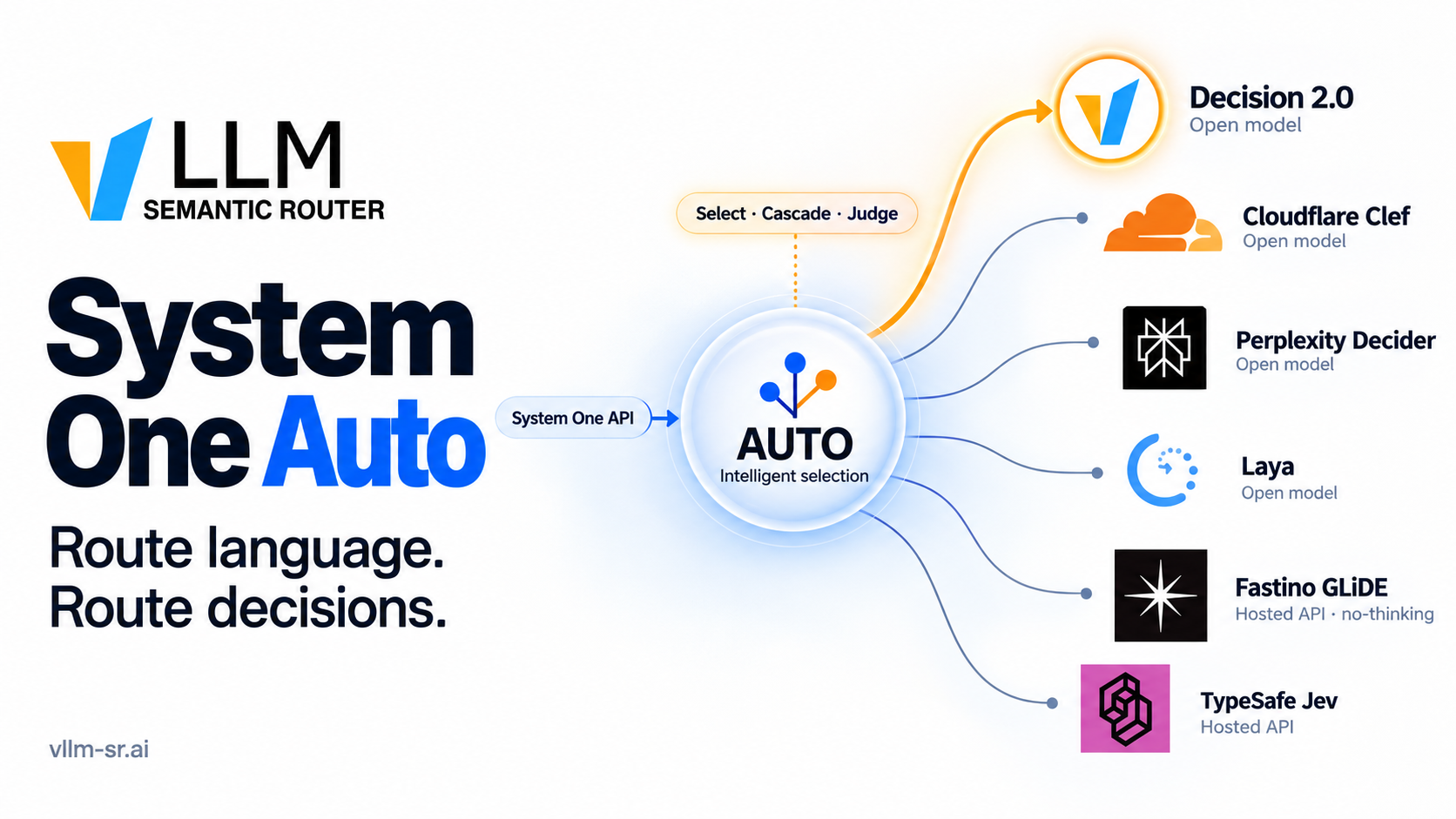
System One Auto intelligently selects from a decision-model pool. An Auto routing hub highlights a selected path among Decision 2.0, Cloudflare Clef, Perplexity Decider, Laya, Fastino GLiDE and TypeSafe Jev. Route language. Route decisions.

One API for a growing decision-model ecosystem. Provider logos illustrate the ecosystem; the experiment below measures Kai → Vega.

Save your largest decision model for the requests that need it.

vLLM Semantic Router already routes across open and closed LLMs. Decision models are becoming a model pool of their own. Open families such as Decision 2.0, Clef, Decider and Laya sit alongside hosted APIs such as Jev and GLiDE. They classify intent, score candidates and check conditions—but which model should handle each request?

Meet System One Auto. Connect self-hosted decision models or compatible hosted APIs behind vllm-sr/auto. Configure how to select a model, when to escalate through a cascade, and whether an LLM judge should review the final candidates. Your application keeps one native API; you choose the model pool and routing policy.

Beyond Prompt Routing: Model Selection, Conversation State, and KV Cache

· 11 min read
Anup Sharma
Engineering @ Sarvam AI
Stefan Wang
Senior Software Engineer at LinkedIn

An agent has completed three turns on model A. It has read a document, stored some facts, and started working toward an answer. The fourth turn needs stronger reasoning, so the router sends it to model B.

The request succeeds. But did the conversation improve?

Model B may receive the entire transcript and still inherit an incorrect answer. Its replica may have to compute the growing prompt again. If a tool call is in flight, changing models can also change how the result is interpreted.

We benchmarked these tradeoffs through vLLM Semantic Router, Envoy, and GPU-backed vLLM servers. In the 960-call holdout, one reactive switching policy reduced strong-model use by 31.8 percentage points and mean session latency by 550 ms compared with a gate-disabled control, but failed three final checks that the control passed. A separate native-tool experiment showed the benefit of choosing a capable model before a difficult boundary.

This is the problem beyond prompt classification: choosing the right model for the next turn without compromising the rest of the task. It also determines where semantic routing belongs in an existing inference stack.

Per-Call Model Selection: Measuring Cost and Quality Across a Multi-Agent Run

· 15 min read
Abhinav Mahajan
Software Engineer at Barclays

Every multi-agent framework asks one question before the first task arrives: which model does each agent use?

planner = Agent(role="planner", model="small-model")
summarizer = Agent(role="summarizer", model="small-model")
reviewer = Agent(role="reviewer", model="frontier-model")
writer = Agent(role="writer", model="small-model")

It looks like configuration. It is really a prediction, made once, about work nobody has seen yet.

A task never reaches a model as one request. It arrives as a stream of calls: list the changed files, summarize a module, search for a concurrency bug, write the final comment. Bind a model to an agent and every one of those calls gets the same answer, hard or trivial.

vLLM Semantic Router moves that choice onto the request. Every agent sends one model name, MoM, short for mixture of models. It is not a model but a virtual name the router resolves per call, from what the call contains, using signals and decisions written in YAML. Throughout this post, local means a small model on your own machine, free and slower, and frontier means a large hosted model, billed per token and fast.

To see what changes, we ran one four-agent crew four ways, all frontier, model per agent, model per call and all local, recording every call: which model served it, which decision chose it, what it cost, and how long the router took to decide.

Per-call routing sent 2 of 16 calls to the frontier model and cost $1.37 per 1,000 reviews. That is one fifth the cost of sending everything to the frontier model, and less than half the cost of a hand-tuned per-agent setup. It found 4 of 6 seeded bugs, matching the all-frontier arm and beating per-agent binding, which found 3. The router took 1.86 ms at p50 to make each choice.